Bangladesh Garment Workers’ New Minimum Wage Fixed at Tk 17,000: Complete Grade-Wise Salary Structure, Industry Impact, and Ground Reactions
After weeks of intense labor unrest, blocked highways, and disrupted export schedules across Bangladesh’s industrial belts, the country’s Minimum Wage Board has finalized a new pay scale for readymade garment (RMG) workers, setting the entry-level monthly minimum wage at Tk 17,000.
The landmark decision, reached in the early hours of Wednesday following a marathon overnight session at the board’s Segunbagicha office in Dhaka, raises the lowest-grade salary by Tk 4,500—a 36 percent increase over the existing Tk 12,500 minimum wage introduced in late 2023. While higher grades saw steeper jumps ranging up to 42.99 percent, the announcement has already drawn sharply divided responses from factory floors in Gazipur and Ashulia to union offices in Dhaka and international labor watchdogs.
For the more than four million workers who form the backbone of Bangladesh’s $38 billion apparel export engine, the revised pay scale brings overdue financial relief—yet many on the ground argue it still falls short of matching everyday living expenses in Dhaka’s sprawling industrial hubs.
Full Grade-by-Grade Breakdown of the New Garments Salary Structure 2026
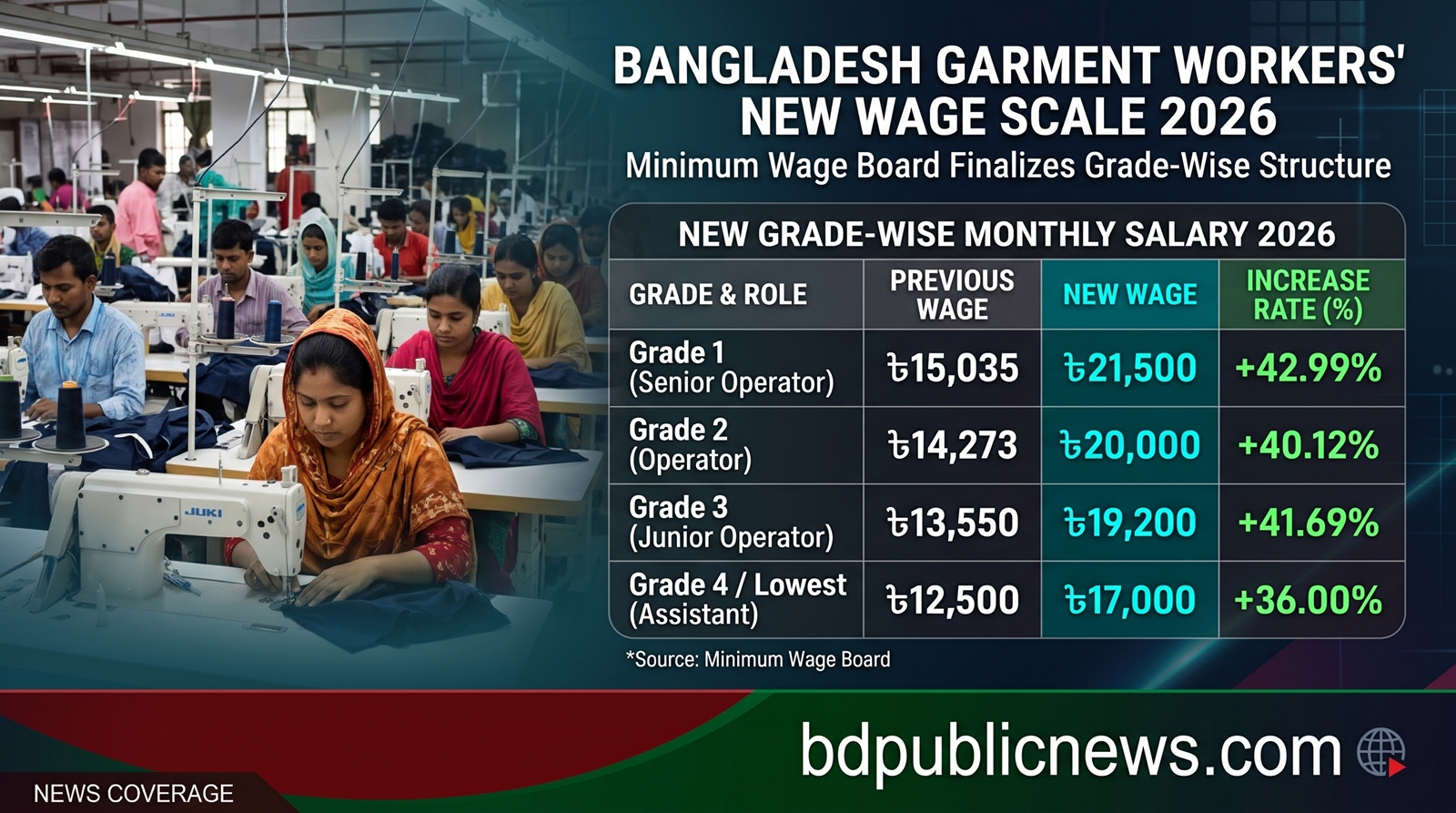
Under the newly finalized four-grade structure released by the Minimum Wage Board, monthly gross wages across the apparel sector have increased between Tk 4,500 and Tk 6,465 depending on skill tier and job role. Senior operators in Grade 1 received the highest monetary and percentage bump, pushing their monthly pay past the Tk 21,000 mark.
Below is the official grade-wise comparison between the previous 2023 pay scale and the newly approved 2026 garment wage structure:
| Grade & Designation | Job Roles Covered | Previous Wage (Tk) | New Wage (Tk) | Increase (Tk) | Increase Rate (%) |
| Grade 1 (Senior Operator) | Senior operators, pattern makers, sample makers | 15,035 | 21,500 | +6,465 | 42.99% |
| Grade 2 (Operator) | Sewing, cutting, finishing, and quality control operators | 14,273 | 20,000 | +5,727 | 40.12% |
| Grade 3 (Junior Operator) | Junior operators, sewing assistants | 13,550 | 19,200 | +5,650 | 41.69% |
| Grade 4 / Lowest Grade (Assistant Operator) | Helpers, thread cutters, line assistants | 12,500 | 17,000 | +4,500 | 36.00% |
Beyond the four headline grades, the wage board introduced an important safeguard for experienced staff: workers who already earn above the newly fixed minimums in their respective tiers will receive an increment of at least Tk 2,000. Individual factories also retain the flexibility to offer higher adjustments based on their operational and financial capacity.
When Does the New Salary Take Effect, and What About Basic Pay?
Local wage board officials confirmed that the revised pay structure is scheduled to come into effect from December 1, 2026, pending the issuance of a formal government gazette notification.
One critical detail still being ironed out is the internal breakdown between basic salary and allowances (house rent, medical, transport, and food). Speaking to reporters around 4:00 AM Wednesday, Wage Board Chairman Judge Syed Azad Subhani stated that the board would reconvene later on Wednesday to determine the exact allocation for basic pay and house rent.
For garment workers, this ratio matters deeply. In Bangladesh’s RMG payroll system, overtime rates, Eid festival bonuses, earned leave encashment, and gratuity are all calculated strictly on the basic salary rather than the gross total. Under the previous Tk 12,500 structure, basic pay stood at Tk 6,700 (with house rent set at 50 percent of basic and fixed allowances totaling Tk 2,450). Labor advocates are watching Wednesday’s follow-up session closely to ensure a higher basic-to-gross ratio so that overtime earnings reflect the headline raise.
Inside the Marathon Wage Board Meeting in Segunbagicha
Arriving at the Tk 17,000 figure was anything but straightforward. Formed on November 1 in response to escalating demonstrations across industrial zones, the six-member Minimum Wage Board—comprising two worker representatives, two employer representatives, an independent member, and the chairman—met for its fourth session on Tuesday afternoon at Segunbagicha.
What began in the afternoon stretched past midnight for nearly 10 to 12 hours of high-stakes bargaining.
- Unanimous Top Tiers: Board members reached consensus relatively smoothly on Grades 1, 2, and 3, finalizing wages at Tk 21,500, Tk 20,000, and Tk 19,200 respectively.
- Deadlock on Entry-Level Pay: The fiercest standoff centered on Grade 4. Early in the broader negotiations, labor representatives had pushed for Tk 32,000 before gradually moderating their position to Tk 22,000 and finally putting Tk 18,000 on the table Tuesday night.
- Employer Counteroffers: Factory owners initially opened talks at Tk 15,000, moved up to Tk 15,700, briefly floated Tk 17,000, and at one tense juncture pulled back to Tk 16,000 as neither side budged.
- The Decisive 4–2 Vote: With consensus out of reach on the lowest tier, the board put the matter to a vote in the early hours of Wednesday. Four members voted in favor of Tk 17,000, while two members backed the workers’ proposal of Tk 18,000, as confirmed by workers’ representative Babul Akhter.
Notably, independent policy analysts had pointed to a slightly higher living-cost floor ahead of the vote. Just days earlier, on November 18, the Centre for Policy Dialogue (CPD) proposed a minimum wage range between Tk 18,578 and Tk 24,204, citing persistent food inflation and rising utility and housing costs in Dhaka, Gazipur, and Savar.
How the 2026 Hike Compares to Previous RMG Wage Revisions
While a Tk 4,500 jump represents a noticeable boost in absolute taka terms, historical data reveals that the 36 percent entry-grade increase is actually Bangladesh’s smallest percentage minimum wage hike for garment workers in over a decade.
- 2013 Wage Revision: Minimum wage increased by 77%
- 2018 Wage Revision: Minimum wage increased by 51%
- 2023 Wage Revision: Minimum wage increased by 56% (reaching Tk 12,500)
- 2026 Wage Revision: Minimum wage increased by 36% (reaching Tk 17,000, or roughly $139 per month)
Unlike the standard five-year statutory wage review cycle, however, the 2026 revision arrived just three years after the December 2023 adjustment. Persistent inflation, currency depreciation, and surging rents in industrial suburbs pushed workers back onto the streets far ahead of the usual schedule, prompting authorities to intervene early.
Mixed Reactions: Highway Blockades in Gazipur vs. Calls for Stability
News of the Tk 17,000 minimum wage spread rapidly across factory lines Wednesday morning, triggering immediate friction in several industrial pockets alongside cautious endorsements from some union leaders.
In Gazipur, dissatisfied workers demanding a Tk 30,000 monthly minimum took to the streets early Wednesday, blocking key stretches of the Dhaka–Mymensingh highway—including Chandana Chowrasta—and parts of the Dhaka–Tangail highway. Commuters faced severe gridlock from morning through midday, forcing factory authorities to declare general holidays across dozens of units—ranging from at least 20 factories in immediate Gazipur hotspots to as many as 70 plants across affected industrial corridors.
Responses from labor leaders and rights groups highlighted the complex tightrope facing the sector:
- Nazma Akter, president of the Sommilito Garments Sramik Federation, rejected the Tk 17,000 benchmark, stating that workers had protested day and night outside the wage board office and that Grade 4 pay should be set at Tk 18,000 at minimum.
- Towhidur Rahman, president of the Bangladesh Apparels Workers Federation, acknowledged that workers hoped for more than Tk 17,000, yet urged them to return to factory floors in the broader long-term interest of the industry.
- Taslima Akter, president of Bangladesh Garment Sramik Sanghati, described the revised structure as a positive step, expressing hope that workers would suspend protests and resume work while urging the government to rein in everyday commodity prices.
- Clean Clothes Campaign, a prominent international garment labor network, criticized the Tk 17,000 rate, labeling the finalized wage exploitative given the rising cost of living.
The High Stakes for Bangladesh’s $38 Billion Apparel Economy
For factory owners and economic policymakers, restoring calm to Ashulia, Savar, and Gazipur is an urgent macroeconomic priority. Bangladesh’s RMG industry accounts for more than 80 percent of the nation’s total export earnings, supplying global retail giants including H&M, Zara, Walmart, Target, Gap, Levi Strauss, and Fruit of the Loom.
The nearly month-long wave of walkouts and blockades struck at the worst possible moment—right before the peak international Christmas shipping window. According to figures released by the Bangladesh Garment Manufacturers and Exporters Association (BGMEA), just 18 days of unrest across 317 factories inflicted an estimated $428 million in financial losses, while export orders worth $254 million were diverted by anxious international buyers to competing manufacturing hubs.
Industry insiders warn that prolonged disruptions could trigger total losses approaching Tk 4,000 crore, placing immense cash-flow pressure on small and mid-sized factories that are simultaneously grappling with high energy costs and tighter bank liquidity. Moving forward, both employers and economists have renewed calls for a transparent, inflation-linked permanent wage-setting framework—one that adjusts worker pay predictably each year rather than waiting for street protests to force emergency negotiations.
Frequently Asked Questions (FAQ) on Bangladesh Garments New Salary 2026
1. What is the new minimum wage for garment workers in Bangladesh in 2026?
The Minimum Wage Board has fixed the new entry-level (Grade 4) monthly minimum wage for garment workers at Tk 17,000, up from Tk 12,500—an increase of Tk 4,500 or 36 percent.
2. How much will a Senior Operator earn under the new garments salary chart?
A Grade 1 Senior Operator will now receive a monthly gross wage of Tk 21,500, representing an increase of Tk 6,465 (42.99%) over the previous Tk 15,035 salary.
3. When will the new Tk 17,000 garment wage structure take effect?
According to Minimum Wage Board officials and local reports, the revised pay scale is scheduled to take effect from December 1, 2026, following formal gazette publication.
4. What happens to garment workers who already earn more than the new minimum wage?
The wage board decided that workers currently earning above the newly fixed minimums in their grade will receive a raise of at least Tk 2,000, with factories permitted to pay more based on financial capability.
5. Why did the Minimum Wage Board vote 4–2 on the final decision?
While all six board members agreed unanimously on Grades 1, 2, and 3, employers and workers remained deadlocked over Grade 4. In the final vote, four members supported Tk 17,000 while two members voted in favor of the workers’ Tk 18,000 proposal.
Whether the new Tk 17,000 benchmark successfully brings lasting stability back to Bangladesh’s factory floors now depends on two immediate tests: how fairly the board splits basic pay from house rent in its follow-up meeting, and whether the government can curb soaring food prices so the hard-won raise actually stretches further in workers’ monthly budgets.